


22 Jun Preparing for Incapacity: The Incapacity Planning Documents You Need Beyond Your Will
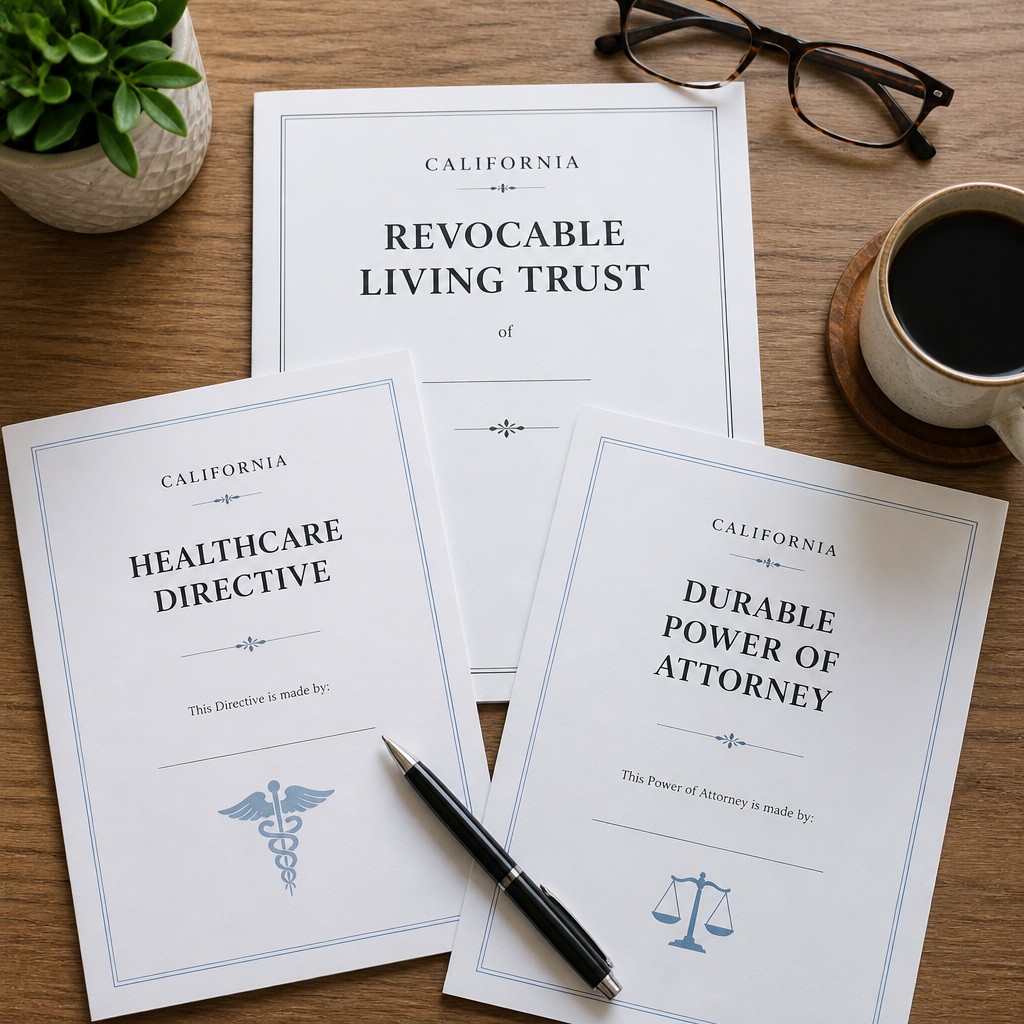
TL;DR
- Incapacity planning documents California — not just your will — determine who controls your money and your medical care if you cannot speak for yourself.
- A durable power of attorney for finances names your agent now. Without it, a court appoints one later — a process that takes months and costs thousands.
- A California Advance Healthcare Directive (AHCD) appoints your healthcare agent and records your medical wishes. It is separate from your will and takes effect while you are alive.
- A POLST form is a physician-signed medical order for people with serious illness or advanced age. It is not a substitute for an AHCD.
- A revocable living trust does two jobs: it lets your successor trustee step in seamlessly if you become incapacitated, and it keeps your estate out of probate when you die. A will alone does neither.
- Digital assets need a plan too. If no one can access your accounts, those assets may be lost permanently.
- All these documents must be signed while you have legal capacity. Once you lose it, the window closes.
Introduction: Your Will Cannot Help You While You Are Alive
Most people know they need a will. Far fewer have the documents that matter most while they are still living.
A will governs what happens after you die. It tells the court who gets your assets, who you trust to carry out your wishes, and who should raise your children. It is an essential document. But dying with only a will still sends your estate through probate — a public court process that typically takes 12 to 18 months in California. Under Probate Code §10810, both the attorney and the executor each collect a statutory fee based on the gross estate value. On a $1 million estate, that is $23,000 each — $46,000 in combined fees before court costs, appraisal fees, or bond premiums. A will alone is not enough.
Here is what a will cannot do: it cannot authorize anyone to pay your mortgage when you are in a hospital bed. It cannot instruct a doctor to remove life support. It cannot keep your business running during a six-month recovery. And it cannot stop a court from appointing a stranger to manage your finances.
These are incapacity planning documents California residents need — the legal tools that answer the question your will never addresses: what happens if something goes wrong and you survive?
California families face a specific set of risks here. Without a durable power of attorney, California Probate Code §1800 requires a court-supervised conservatorship before anyone can act on your behalf financially. That process typically takes 3 to 6 months to establish, costs $5,000 to $15,000 or more, and runs $2,000 to $5,000 per year in ongoing court filings. All of it is public record.
This article covers the full set of documents you need — and what each one actually does.
Durable Power of Attorney for Finances
A durable power of attorney (DPOA) for finances is a legal document that authorizes a person you choose — your agent — to manage your financial and legal affairs on your behalf. Under California Probate Code §4124, a durable power of attorney remains effective even if you become incapacitated. That is the “durable” part — it survives incapacity, which is exactly when you need it most.
Without a DPOA, no one — not even a spouse — has automatic legal authority to manage individually held accounts, sign contracts, pay bills, or make financial decisions on your behalf. California has no spousal right of automatic agency. The court fills that gap through conservatorship. The DPOA eliminates that gap before it exists.
Immediate vs. Springing: Which Type to Use
Immediate DPOA: Takes effect the moment you sign it. Your agent can act on your behalf right away, whether or not you are incapacitated. This is the more practical choice for most people — it avoids the need to produce medical documentation of incapacity before your agent can act.
Springing DPOA: Becomes effective only when you are certified as incapacitated — typically requiring one or two physician declarations. This sounds protective, but it creates delays and procedural hurdles at exactly the moment you need fast action. Many California estate planning professionals advise against springing powers unless there is a specific reason to use one.
Both types must be either acknowledged before a notary public or signed by two qualified witnesses, as required by California Probate Code §4121. Notarization is the standard in practice and is required by most financial institutions.
What Powers You Can Grant
Your DPOA can be broad or specific. A general DPOA typically authorizes your agent to manage bank accounts, pay bills, handle investments, file tax returns, manage real estate, operate a business, apply for government benefits, make gifts, and manage retirement accounts. You can restrict any of these. You can add specific authority your situation requires.
California provides a statutory DPOA form under Probate Code §4401. It is widely recognized by financial institutions and third parties in California, which is one of its practical advantages.
Choosing the Right Agent
Your agent does not need to be a financial expert. They need to be someone you trust completely, someone who will act in your interest, and someone who is organized and responsive under pressure. A spouse or adult child is the most common choice. A trusted sibling or close friend works too. The wrong choice is someone under financial stress, someone with a conflict of interest, or someone who has never managed money responsibly.
Name a successor agent — someone who steps in if your first choice is unavailable, unwilling, or dies. One backup is the minimum; two is better.
Note: The following scenario is for illustrative purposes only. It does not represent a real Guideway client or actual case.
Illustrative example: An Oakland business owner suffers a serious stroke at 58. His wife is named as agent in his immediate DPOA. The following week she contacts their bank, presents the document, and is authorized to manage accounts within the same day. She pays business overhead, services the mortgage, and handles a client contract renewal — all without a court order, an attorney filing, or a waiting period. His business survives the disruption. His recovery happens without financial chaos running alongside it.
Advance Healthcare Directive
California’s Advance Healthcare Directive (AHCD) is the document that governs medical decisions when you cannot make or communicate them yourself. It is governed by California Probate Code §4700–4806 and does two things at once: it appoints a healthcare agent and it records your own medical wishes.
Without an AHCD, medical providers must follow a statutory priority order when seeking consent — typically starting with a spouse, then adult children, then parents. That order may not match your actual wishes. And in some medical situations, particularly end-of-life decisions, disagreement among family members can leave providers in an impossible position.
Appointing a Healthcare Agent
Your healthcare agent is authorized to make medical decisions on your behalf when you cannot. Their authority covers consenting to or refusing treatment, choosing healthcare providers, accessing medical records, and making placement decisions (such as choosing a skilled nursing facility). They are bound to follow your documented wishes — or, when no specific instruction applies, to act in your best interest.
Choose someone who will advocate for you, not someone who will be paralyzed by grief. This is a different skill set than managing finances. The best healthcare agent is someone who can communicate clearly with medical providers, make decisions under pressure, and carry out your wishes even when other family members disagree.
Documenting Your Medical Wishes
The AHCD includes space to document your preferences about specific types of care: mechanical ventilation, artificial nutrition and hydration, resuscitation, pain management, and end-of-life comfort care. You do not have to complete every section. But the more specific you are, the less your agent has to guess — and the less room there is for family conflict.
HIPAA Authorization
Your AHCD typically includes a HIPAA release authorizing your healthcare agent to receive your medical information. Without this, HIPAA privacy rules can limit what providers will share with your agent — creating practical obstacles at the worst possible moment. Make sure yours is current.
The California Attorney General provides an official AHCD form at oag.ca.gov/consumers/general/care. Guideway can prepare a complete, properly executed AHCD as part of your incapacity planning documents.
Note: The following scenario is for illustrative purposes only. It does not represent a real Guideway client or actual case.
Illustrative example: A Walnut Creek couple, both in their early 70s, each has an AHCD naming the other as healthcare agent. The wife is hospitalized unexpectedly after a fall and cannot speak. The husband presents her AHCD to the care team on arrival. Her treatment preferences are documented. He is recognized as her healthcare agent immediately. Medical decisions proceed in line with what she wanted. No family conflict arises because her wishes are already on paper.
POLST Forms: What They Are and When They Apply
A POLST form — Physician Orders for Life-Sustaining Treatment — is sometimes confused with an Advance Healthcare Directive. They are different documents serving different purposes.
An AHCD is a legal document you create yourself, in advance, that appoints a healthcare agent and records your general wishes. It applies broadly to any situation where you cannot make medical decisions.
A POLST form is a physician-signed medical order, completed in collaboration with your care provider, that gives specific instructions about life-sustaining treatment. It is part of your medical record and speaks directly to emergency responders and healthcare providers — including when an AHCD would typically require interpretation.
When a POLST Is Appropriate
POLST forms are appropriate for:
- Patients with a serious illness (advanced cancer, late-stage heart disease, end-stage organ failure)
- People with advanced age and frailty who have a high risk of a medical emergency
- Anyone who has clear, specific preferences about resuscitation, mechanical ventilation, or hospitalization that they want immediately honored without interpretation
POLST forms are not a substitute for an AHCD. Most healthy adults preparing general incapacity documents do not need a POLST. If you have a serious chronic illness or are in an advanced care setting, ask your physician whether a POLST is appropriate for your situation.
The California POLST form is available at capolst.org and must be signed by a licensed California physician, physician assistant, or nurse practitioner to be valid.
The key distinction: your AHCD speaks through your agent when you cannot speak. Your POLST speaks directly to medical providers as a standing order.
Revocable Living Trust: Incapacity Planning and Probate Avoidance

Most people think of a living trust as a probate-avoidance tool. It is. But it also does something that powers of attorney cannot fully replicate: it provides a seamless, private, court-free mechanism for managing your assets if you become incapacitated.
Here is how it works. When you create a revocable living trust, you transfer ownership of your assets — your home, bank accounts, investment accounts — into the trust. You serve as your own trustee while you are able. If you become incapacitated, your named successor trustee steps in and takes over management of all trust assets. They do not need a court order. They do not need to go through a conservatorship proceeding. They do not need to post a bond or file annual accountings. They simply present the trust document and act.
What a Successor Trustee Can Do
Your successor trustee can pay bills, manage investments, sell property (if necessary), and handle all financial obligations covered by trust assets. They are bound by the terms of the trust document and by California fiduciary duty law — they must act in your interest and in accordance with your instructions.
Assets outside the trust — accounts you never transferred in, vehicles titled in your name alone — are not covered by the successor trustee’s authority. This is why trust funding matters. An unfunded or partially funded trust creates gaps your successor trustee cannot fill. Your DPOA covers these gaps, which is why the two documents are designed to work together.
Avoiding Conservatorship Through a Trust
A properly funded revocable living trust eliminates the need for a conservatorship proceeding over trust assets. Your successor trustee’s authority is private and immediate. No petition, no court hearing, no public record. If all — or nearly all — of your significant assets are in the trust, the case for court involvement largely disappears.
For assets outside the trust, your DPOA fills in. Together, a funded trust and a current DPOA give your family the tools to manage virtually any incapacity situation without involving the courts.
Note: The following scenario is for illustrative purposes only. It does not represent a real Guideway client or actual case.
Illustrative example: A Tri-Valley couple in their mid-60s has a revocable living trust, fully funded, with their home, savings accounts, and investment accounts all titled in the trust’s name. The wife develops early-onset dementia and can no longer manage her affairs. Her husband, the successor co-trustee, steps in and manages all trust assets without any court process. When he later needs help, their adult daughter — named as the next successor trustee — takes over. The family’s finances remain private, continuous, and uninterrupted throughout.
Digital Asset Access: The Incapacity Problem No One Talks About

What happens to your online banking, email, investment platforms, and cryptocurrency accounts if you become incapacitated and no one knows your passwords? The answer, in many cases, is: nothing good.
California’s Revised Uniform Fiduciary Access to Digital Assets Act (RUFADAA), California Probate Code §870 et seq., gives your agent or trustee the legal right to access your digital assets — but only if your planning documents specifically authorize it and only when the platform’s terms of service permit it. Legal authority and practical access are not the same thing.
Practical Steps for Digital Asset Planning
- Authorize access in your DPOA and trust: Both documents should explicitly authorize access to digital assets under California Probate Code §§870–884. Without this language, your agent may face resistance even with legal authority.
- Use a password manager: Services like 1Password or Bitwarden let you store credentials securely and share emergency access with a trusted person. Your agent knowing the master password — stored in a sealed letter or secure document — is a practical solution.
- Prepare a digital asset inventory: List your significant accounts (financial platforms, email, social media, cloud storage, cryptocurrency), where they are held, and how they are accessed. Store this securely and tell your agent where it is.
- Use platform-specific legacy tools: Google’s Inactive Account Manager and Apple’s Legacy Contact feature let you designate someone to access your account. Facebook has a Legacy Contact feature for memorialization. Use them where available.
- Cryptocurrency: Crypto held in a self-custody wallet is lost permanently if no one has the seed phrase. If you hold cryptocurrency, your recovery phrase must be stored somewhere your successor trustee or agent can find it. Without it, those assets are gone.
Digital asset planning is not technically complex. It requires a list, a secure storage solution, and explicit language in your legal documents. What it prevents — months of locked accounts, lost assets, and frustrated agents — is worth the hour it takes.
Coordinating All Your Incapacity Documents
Having each of these documents is necessary. Having them work together is essential. Gaps and inconsistencies across your estate plan can create exactly the kind of confusion and conflict you are trying to prevent.
Common Coordination Problems to Avoid
- Different agents named in different documents: Your DPOA agent and your AHCD healthcare agent do not have to be the same person — and often should not be. One is a financial role; the other is a medical role. But they need to know about each other and be able to communicate.
- Trust and DPOA covering the same assets: If your home is in your trust, your successor trustee manages it during incapacity — not your DPOA agent. Your DPOA agent handles assets outside the trust. Make sure your agent knows what falls under their authority.
- Outdated agent designations: An agent who has died, moved away, lost your trust, or become incapacitated themselves is no problem to fix in advance and a serious problem to discover mid-crisis. Review your documents after any major life change.
- AHCD not reflecting your current wishes: Treatment preferences can change, especially as health conditions evolve. An AHCD from ten years ago may no longer reflect what you want. Review it periodically.
When to Review and Update
Review your incapacity documents after:
- A major health diagnosis (yours or your agent’s)
- A significant relationship change (marriage, divorce, death of a named agent)
- A move to a new state (check portability of California documents)
- A substantial change in assets (new real estate, business acquisition, large inheritance)
- Any time five or more years have passed since your last review
Secure Storage and Access
Your documents are only useful if the right people can find them. Store originals in a fireproof safe, a secure home location, or with your document preparer. Do not put them in a safe deposit box only — no one can access a safe deposit box without court authorization after you become incapacitated.
Give copies to your DPOA agent, your healthcare agent, and your successor trustee — today. Tell them where the originals are. Store digital copies in a location your agents can access remotely if needed.
Your Next Step
A will is where most people start with estate planning. Incapacity documents are where the real work is.
Your will takes effect after you die — but a will alone still sends your estate through probate, a public court process that takes 12 to 18 months in California. Under Probate Code §10810, both the attorney and the executor each collect a statutory fee based on the gross estate value. On a $1 million estate, that is $23,000 each — $46,000 in combined fees before court costs, appraisal fees, or bond premiums. A funded living trust avoids probate entirely. A durable power of attorney, an advance healthcare directive, and a funded living trust take effect when you need them most — during the years you might be alive but unable to speak, act, or decide for yourself, and at death to keep your estate out of court. Those are the documents that protect your finances, carry out your medical wishes, and spare your family from courts, costs, and conflict.
Every one of these documents requires legal capacity to sign. Once you lose the ability to understand and consent, the window closes. The conservatorship process — expensive, public, and slow — is what California law provides when planning documents do not exist.
Guideway prepares durable powers of attorney, advance healthcare directives, revocable living trusts, and wills for Bay Area families. We are registered legal document preparers — not attorneys — serving clients in Walnut Creek, Oakland, and Tri-Valley. We cannot give legal advice, but we can prepare your documents correctly, in compliance with California law, with in-office notarization available.
For questions requiring a licensed attorney — contested matters, specialized tax planning, or complex business structures — we can refer you to a California State Bar certified referral service.
Schedule your consultation at guidewaylegal.com/contact. Walnut Creek: (925) 407-1010 | Oakland: (510) 452-2320 | Tri-Valley: (925) 479-9600
Key Terms
Durable Power of Attorney (DPOA): A legal document authorizing a person you choose to manage your financial and legal affairs if you become incapacitated. “Durable” means it remains effective after incapacity, per California Probate Code §4124.
Advance Healthcare Directive (AHCD): A California document that appoints a healthcare agent to make medical decisions when you cannot, and records your own treatment wishes. Governed by California Probate Code §4700–4806.
POLST Form: Physician Orders for Life-Sustaining Treatment. A physician-signed medical order giving specific instructions about resuscitation, ventilation, and hospitalization. Appropriate for people with serious illness or advanced age.
Revocable Living Trust: A legal arrangement you create during your lifetime that holds your assets and authorizes your successor trustee to manage them if you become incapacitated or after you die, without court involvement.
Successor Trustee: The person named in your trust who takes over management of trust assets if you become incapacitated or die. Not the same role as a DPOA agent, which covers assets outside the trust.
Conservatorship: A court process required when an adult becomes incapacitated without planning documents in place. A judge appoints someone to manage finances and/or personal care. Typically takes 3–6 months and costs $5,000–$15,000+ to establish.
Legal Capacity: The ability to understand and consent to a legal document. Must be present when you sign a DPOA or AHCD. Once lost, these documents can no longer be created.
RUFADAA: California’s Revised Uniform Fiduciary Access to Digital Assets Act (Probate Code §870 et seq.), authorizing agents and trustees to access digital accounts when explicitly authorized in planning documents.
When to Consult a Professional
Guideway prepares incapacity planning documents as part of complete estate plans. Our scope covers document preparation, not legal advice. Here is how to think about which kind of help you need:
- Guideway can help with: Durable powers of attorney, advance healthcare directives, revocable living trusts, wills, deed transfers, and in-office notarization.
- Consult a licensed California attorney for: Contested conservatorship proceedings, complex business structures, Medi-Cal planning, or any situation involving legal disputes or representation.
- Consult a CPA or tax attorney for: Income tax implications of trust funding, estate tax planning, or any question about how incapacity affects your tax situation. We are not tax experts, but we can refer you to professionals who are.
We are not attorneys. We can only provide self-help services at your specific direction. Guideway Legal Document and Mediation Services is not a law firm, and we cannot represent customers, select legal forms, or give legal or tax advice. Services are provided at customers’ requests and are not a substitute for advice of a lawyer. Because legal needs vary from individual to individual, you should seek the advice of a licensed attorney if you have any questions regarding the selection of appropriate forms. You can find an attorney at a State Bar approved Lawyer Referral Service. Prices do not include court costs. Guideway is based at 925 Ygnacio Valley Road, Suite 204, Walnut Creek, CA 94596. We are registered as Contra Costa County LDA #188 and Alameda County LDA #169, expiry January 2027.
What is the difference between a durable power of attorney and an advance healthcare directive in California?
A durable power of attorney authorizes your agent to manage your finances and legal affairs when you cannot. An advance healthcare directive authorizes your healthcare agent to make medical decisions and records your treatment wishes. Both are incapacity planning documents. You need both — they cover different domains. Neither is a will, which only takes effect after death.
Does a revocable living trust replace my durable power of attorney?
No. A revocable living trust lets your successor trustee manage trust assets during incapacity without court involvement. But assets held outside the trust — accounts never transferred in, vehicles, and other property — are not covered by your trustee's authority. Your durable power of attorney covers those. The two documents are designed to work together. A fully funded trust plus a current DPOA gives your family the most complete protection.
When should I sign incapacity planning documents in California?
Now, regardless of age or health. Every incapacity planning document — a durable power of attorney, advance healthcare directive, and trust amendments — requires legal capacity at the time of signing. That means you must understand what you are signing and be making a voluntary decision. Once you lose capacity, whether from dementia, a stroke, or an accident, you can no longer create these documents. California courts then step in through conservatorship. Signing these documents is straightforward and does not take long. Waiting is the only real risk.